
Your Gut Is Talking—Are You Listening?
Sep 26, 2026

Why a Food Diary Can Be One of Your Most Powerful Gut Health Tools
Have you ever eaten something and thought: “Why does my stomach feel like this?”
Maybe you feel bloated after a meal. Maybe you suddenly have gas, constipation, loose stools, heartburn, or abdominal discomfort. Or maybe you feel completely fine one day after eating a particular food—and uncomfortable the next time you eat it.
This can be incredibly frustrating.
And when you don't know what's causing the problem, it's easy to start eliminating food after food until you're afraid to eat anything.
But there may be a simpler place to start: a food diary. A food diary isn't about counting calories. It isn't about judging what you eat. And it certainly isn't about creating another complicated set of food rules. It's about gathering information.
Your food diary can help you slow down, notice patterns, and better understand how your food, lifestyle, and digestive symptoms may be connected.
So, What Exactly Is a Food Diary?
A food diary is simply a record of what you eat and drink along with information about how you feel afterward.
You might record:
- What you ate
- What you drank
- Approximately how much you ate
- What time you ate
- Your digestive symptoms
- Your bowel movement
- Your stress level
- How well you slept
- Your energy level
- Anything else that seems relevant
You don't need a fancy app. A notebook, printed worksheet, or notes on your phone can work. The important part is consistency. Health professionals sometimes recommend food and symptom diaries because they can help identify patterns between foods, drinks, and digestive symptoms.
Why Is a Food Diary Important for Gut Health?
1. It Helps You See Patterns You Might Otherwise Miss
Our memories aren't always great at connecting a food with a symptom that happens hours later.
For example: You eat lunch at noon. You feel bloated at 4:00. By dinner, you may not even remember exactly what was in your lunch. A food diary gives you something much more useful than memory: a record. Over several days, you may begin noticing patterns. Perhaps your bloating tends to happen after certain meals.
Maybe constipation is worse when your water intake is low. Maybe your symptoms are more noticeable when you're eating quickly or under stress. The diary doesn't automatically tell you why something is happening. But it can help you identify patterns worth paying attention to.
2. It Helps You Become Your Own Detective
One of the biggest problems with gut health is information overload.
One person says:
“You need to avoid dairy.”
Someone else says:
“Gluten is the problem.”
Another person says:
“It's FODMAPs.”
Then someone else tells you to remove sugar, nightshades, lectins, grains, or dozens of other foods.
Before long, you're following a diet that barely contains any food.
Instead of immediately removing everything, start by asking: “What can I learn about my own body?” Your food diary becomes your detective notebook.
You're looking for clues.
3. It Can Help You Identify Possible Food Triggers
A food diary may help you notice that certain foods or drinks repeatedly occur around your symptoms.
For example:
Monday:
You eat a large portion of a particular food and experience bloating several hours later.
Wednesday:
You eat the same food again and notice similar symptoms.
Friday:
You eat it in a smaller amount and notice little or no discomfort.
Now you have something interesting to investigate.
It could be the food.
It could be the amount.
It could be what you ate with it.
It could be your stress level.
It could be your overall digestive health.
It could be something completely unrelated.
That's why a food diary is about finding patterns—not jumping to conclusions.
4. It Helps You Look Beyond Food
This is one of the most important reasons I recommend keeping a food diary.
Your gut doesn't operate in isolation. Your digestion can be influenced by more than what's on your plate. That's why I like including a few lifestyle factors in your diary.
For example:
Food
What did you eat and drink?
Timing
When did you eat?
Symptoms
What did you notice afterward?
Stress
Were you relaxed, rushed, worried, or overwhelmed?
Sleep
Did you sleep well the night before?
Movement
Did you walk or exercise?
Bowel habits
Did you have a bowel movement? What was it like?
Hydration
Did you drink enough fluids?
These additional pieces of information can give you a much bigger picture.
Monash University, for example, includes food intake, IBS symptoms, bowel habits, and stress in its symptom diary approach.
5. It Can Help You Notice What Makes Your Gut Feel BETTER
This is something I don't want you to overlook. A food diary isn't just about finding "bad" foods. Look for your wins, too.
Maybe you notice:
- You feel better when you eat slowly.
- Your digestion is better when you drink more water.
- Your bowel movements improve when you consistently eat vegetables.
- You feel less bloated when you eat smaller portions.
- You have more energy when you eat a balanced breakfast.
- You digest dinner better when you aren't eating right before bed.
- Your symptoms are calmer when you take time to relax before eating.
Those are valuable discoveries.
Instead of asking only: “What food is hurting me?” also ask: “What seems to help my body feel better?” That's a much more empowering approach.
What Should You Actually Track?
Don't make this complicated. Here's a simple starting point:
Track This Example
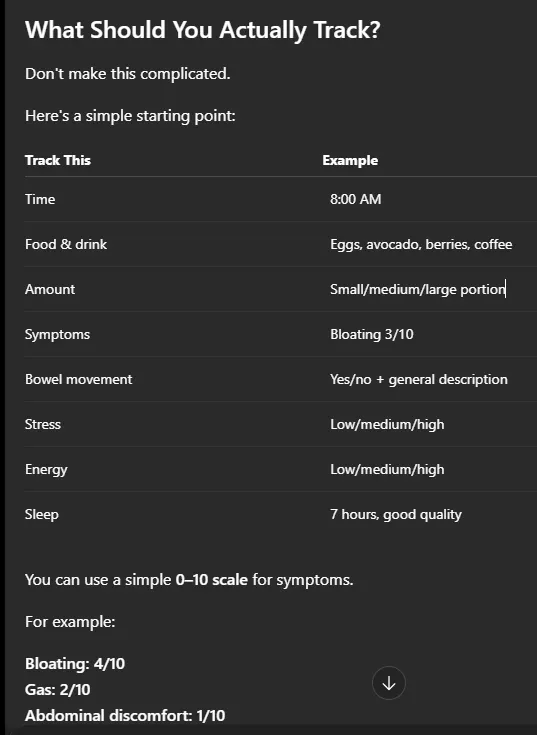
This makes it easier to notice whether things are changing over time.
How Long Should You Keep a Food Diary?
You don't necessarily need to track every bite forever.
The goal is to collect enough information to identify useful patterns.
For many people, starting with 7–14 days can provide a helpful snapshot.
But the exact timeframe depends on the symptoms and what you're trying to learn.
And remember: Consistency is more important than perfection.
If you forget to record one meal, don't give up. Just start again with the next meal.
Don't Change Everything at Once
This is where many people get stuck.
They start a food diary on Monday.
By Tuesday, they've eliminated dairy.
By Wednesday, they've removed gluten.
By Thursday, they're avoiding sugar.
By Friday, they're eating only six foods.
Now they don't know what actually helped.
Instead: Observe first.
Then make one reasonable change. Give your body some time.
Observe again. This creates a much clearer learning process.
Your Food Diary Is Not a Judgment Tool
This is important.
Your food diary isn't there to tell you that you were "good" or "bad."
You don't need to write:
❌ “I cheated.”
❌ “I was bad today.”
❌ “I shouldn't have eaten that.”
Instead, write:
“I ate pizza at 7:00 PM. I noticed bloating around 9:00 PM.”
That's information.
Not failure.
You are collecting clues about your body.
What If Every Food You Eat, no matter what you do, causes symptoms?
That is something you need to talk to your doctor about immediately. There are a few reasons that can be easily remedied with a supplement or medication or it could be a more serious digestive dysfunction. You have to be careful with this level of food sensitivity as this can affect nutrition absorption. Poor nutrition can be very damaging to your gut and your health.
What If You Don't Find Any Patterns?
That's okay, too. A food diary doesn't guarantee that you'll discover a single food responsible for your symptoms. Digestive symptoms can have many possible causes, and food is only one piece of the puzzle.
Your diary can still provide useful information for a conversation with your doctor, registered dietitian, or other qualified healthcare professional. Doctors may ask patients to keep a diary of foods, drinks, and symptoms when evaluating digestive complaints.And if you're experiencing persistent, severe, or concerning digestive symptoms, don't rely on a food diary alone. Talk with your healthcare professional.
The Biggest Benefit? Awareness.
Sometimes the most powerful thing you can do for your gut isn't another supplement. It isn't another elimination diet. It isn't another complicated protocol.
Sometimes it's simply paying attention.
A food diary helps you slow down and start connecting the dots between:
What you eat → how you live → how you feel. And once you have better information, you can make better decisions. Small changes, made consistently, can add up.
Your Gut Health Homework
For the next 7 days, try this:
Before you eat:
Ask:
“How hungry am I?”
While you eat:
Slow down and actually notice your meal.
After you eat:
Ask:
“How does my body feel?”
Then write it down.
Don't try to be perfect.
Don't try to figure everything out in one week.
Just start paying attention.
Your body is giving you information every day.
A food diary simply gives you a place to listen.
Remember:
You don't have to fear your food.
You need to understand your body.
And sometimes, the first step toward better gut health is simply becoming curious about what your body has been trying to tell you.
Click here for my DIY Gut Health Food Diary
To your beautiful wellness and thriving for life,
Joan
Journeytoholisticwellness.com